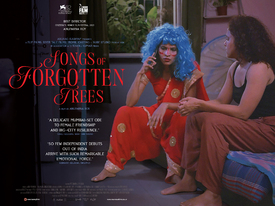
For this film, Anuparna Roy was the winner of the Best Director award in the Horizzonti section, Venice Film Festival 2025.
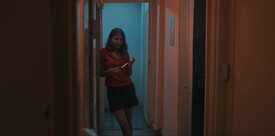
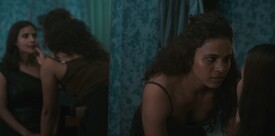
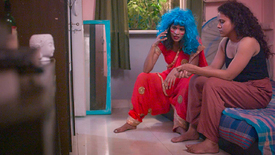
Thooya (Naaz Shaikh), a migrant and aspiring actress, spends her days moonlighting as a sex worker in her apartment, attending virtual therapy, and shedding her inhibitions in acting class. New to Mumbai, Thooya rents out her spare room to the quiet Shweta (Sumi Baghel), who works in a call centre and is also new to Mumbai.
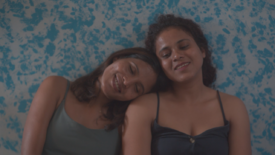
Taking a little time to warm up, they soon start to build a connection, one in which they rely on each other, building their own cocoon far away from the noise and challenges of the oppressive city. But as the realities of how the two women live their lives begin to clash, the fragile bond is tested.
What unfolds is a quiet blooming of selfhood, survival, and a kinship between women navigating a world that rarely sees them.
BBFC cert 15
Anuparna Roy Director
Filmography Selected
Indian writer and director (b. 1994) from Narayanpur, a small village in Purulia, West Bengal, Anuparna Roy graduated in English literature from Burdwan University and later pursued studies in mass communications. Before entering the film industry, she worked as an IT sales executive. In 2021, deciding to change fields, she studied acting and eventually moved behind the camera to write and direct her first short film, Run to the River (2023). Songs of Forgotten Trees was her feature debut and earned her the Best Director Award in the Orizzonti section of the Venice Film Festival. She was the first Indian woman to receive this distinction.
Beyond cinema, Anuparna is also a published writer. Her article addressing the rights of minorities, the aftermath of the controversial new citizenship law and the lives of Bay of Bengal refugees was featured on Word is One News (a widely viewed news channel based in India). Now based in Mumbai, she is actively developing new scripts. Her current work explores themes rooted in Third World cinema, female agency, and marginalized narratives.
RUN TO THE RIVER short (2023)
SONGS OF FORGOTTEN TREES (2025)
LOVERS IN THE BLUE NIGHT (2026)
"Roy’s approach is melodic and understated, and mines drama from human corners where other storytellers might not think to look…
On the surface, one might be tempted to compare Roy to Payal Kapadia, whose 2024 drama All We Imagine As Light—a recent tale of friendship between Mumbai’s migrant women—but Roy’s style is a much closer cousin to Ryusuke Hamaguchi, who western viewers might know from Drive My Car. Her camera is far less steady than Hamaguchi’s (with the purpose of embodying interpersonal tension), but her scenes similarly unfold in lengthy two-shots of characters speaking, and speaking, and speaking, until suddenly, meaning and weight punch through the façade of casual chatter about sex and sexuality (a topic that’s a rarity in Indian cinema)….
...so few independent debuts out of India arrive with such remarkable emotional force."
Siddhant Adlakha, Observer
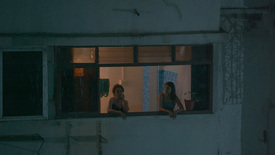
"A delicate Mumbai-set ode to female friendship and big-city resilience....An early montage in Songs of Forgotten Trees depicts Mumbai buildings filled with cramped, shoebox-sized apartments, an evocative visual for a film about Indian women scrambling for societal space. Within these walls, roommates Thooya (Naaz Shaikh) and Shweta (Sumi Baghel) are further hemmed in, filmed through slivers of doorway, inside a mosquito net and reflected in shards of a mirror. And yet, a fragile, tender intimacy between them finds room to expand."
Gayle Sequeira, Sight and Sound
"A sex worker and a call centre employee forge an ambiguous relationship in a film of strong feelings...
Cath Clarke, The Guardian
“A clear-eyed, restrained, moving story of two young women, lonely and bruised, finding solace in each other.The heart of this film is a scene in which the two women are in two bathrooms next to each...what starts out as buoyant banter shifts seamlessly into grief and tears. The scene is beautifully staged and performed.”
Anupama Chopra, The Hollywood Reporter
★★★★ “A remarkably restrained and quiet film. With sensitivity, Roy invites us to contemplate what it means to truly see another person, and how often we fail to do so, even in our most intimate relationships. It is a film about longing, distance, and the fragile, flickering moments of connection that we chase despite knowing they may never fully arrive.”
Walter Neto, International Cinephile Society
"...you can see Songs of Forgotten Trees growing before your eyes: we're watching and living with Mumbaikars we know here - or people we feel we know almost intimately by the time cinema protocol requires us to move out...Both these actresses are very watchable: skilfully suggesting a growing bond while maintaining distinct personalities."
Mike McCahill, Cinethésiac
"Both lead performances are consistently brilliant, embodying the film's naturalistic storytelling style perfectly. Thooya is seeking redemption and catharsis in sex work, and Shwetha is relentlessly chasing a middle-class fantasy of marriage and a corporate career...both are inadvertently running away from themselvees, only they don't fully realise it yet. Roy's empathetic gaze lets these characters exist in their messiness, without judging them for not seeing things that might seem more obvious to an external observer.
Kaashif Hajee, The Wire
★★★★
"Although Songs of Forgotten Trees is Anuparna Roy's first feature, one can state with absolute confidence that it shows her to be possessed of a totally individual voice. That was in effect recognised at the 2025 Venice Film Festival when her film won her an award for best director but the personal stamp that marks the piece stems just as much from the character of the screenplay which she wrote herself.
Mansel Stimpson,, Film Review Daily
"Running just 77 minutes, it still manages to offer potent insights into such issues as urban alienation, male entitlement, past associations, the shaping of destinym and the performativee nature of modern life.
Full of glances and gestures with maniford meanings, this is a delicate drama with an enigmatic ending that leaves viewers with lots to think about."
David Parkinson, ParkyathePictures
"A bold and frank depiction of women in the third world country and the struggles they face and have to overcome to merely make a mark and maintain employment. Helped by two sterling performances by Shaikh and Baghhel, this is a film that despite the short runtime will stay with you long after the fact."
Jamie Garwood, Chatter Box Film